Good evening, Worshipful Master, officers, and brethren.
The following wasn't derived by any one source or reference but ideas from 3 primary masonic sources that I would be happy to share if requested.
This evening, I'd like to spend a few minutes reflecting on a simple question about a term that we hear every time we enter this lodge, yet perhaps don't think about nearly enough:
Why do we call each other "Brother?"
It's a word we use so often that it can become routine. We often greet one another as Brother Brent, Brother Jon, Brother Lucas and so on. But have you ever stopped to consider what that word truly means?
In today's world, the word brother is often used casually. Athletes call each other brother. Military members do. Police officers, firefighters, and close friends often use it as a sign of camaraderie. I've used the word in nearly all the aforementioned instances. And while those relationships are meaningful, our use of the word carries a deeper significance.
When we become Freemasons, we are not simply joining an organization-we are entering into a fraternity founded on shared principles, mutual obligations, and a commitment to help one another become better men. The title of "Brother" is not bestowed because of where we come from, what we do for a living, or how long we have been members. It is earned through a shared commitment to the values of our Craft.
That commitment begins with one important truth:
Brotherhood is not based on sameness. It is based on shared principles.
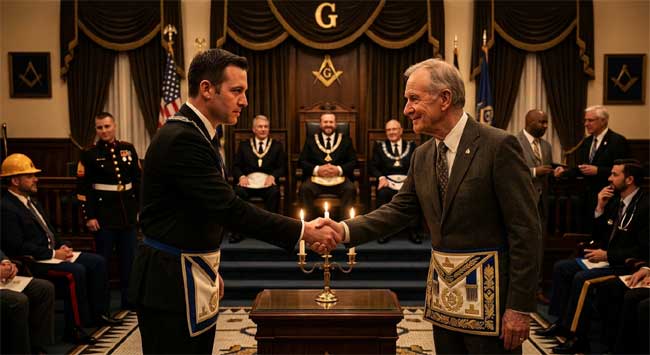
Within this lodge, we have men from different professions, political viewpoints, religious traditions, educational backgrounds, and life experiences. Outside these walls, those differences might divide us. Inside these walls, they become secondary to the values we have pledged to uphold.
I have personally found that to be one of Freemasonry's greatest strengths.
The Level reminds us that every man enters the lodge on equal ground. No title, occupation, or social status gives one brother greater worth than another. We meet each other as equals because our character matters more than our accomplishments.
But equality is only the beginning.
Calling someone "Brother" carries responsibility.
It means celebrating another Mason's successes without jealousy. It means offering encouragement during difficult times. It means checking on the brother who hasn't attended lodge in months-not to question his absence, but because we genuinely care about his well-being.
Sometimes brotherhood means listening instead of speaking. Sometimes it means offering correction with kindness.
Sometimes it means extending forgiveness when misunderstandings occur.
And sometimes it simply means showing up.
The strongest lodges are rarely those with the most members. They are the lodges where the brethren genuinely care about one another beyond the monthly meeting.
Our fraternity teaches three great principles: Brotherly Love, Relief, and Truth. Brotherly Love asks us to respect every person's dignity.
Relief reminds us that our obligations extend beyond words into action. Truth challenges us to live honestly and with integrity.
Notice that none of these principles are passive. They require effort. Brotherhood is something we practice-not merely something we claim.
As I reflected on this topic, I thought about families.
Every family experiences disagreements. Brothers don't always see eye to eye. Yet healthy families remain united because the relationship is more important than the disagreement.
Our lodge is no different.
We may disagree about Lodge business, traditions, or the direction we should take. Those discussions are healthy. But when the meeting closes, we should leave as brothers, remembering that our unity is stronger than our differences.
The outside world offers plenty of division. Freemasonry should offer something different.
It should be a place where men can disagree respectfully, learn from one another, and leave stronger because they shared the experience together.
Another aspect of brotherhood is accountability.
A true brother doesn't simply tell us what we want to hear. He tells us what we need to hear.
He encourages us when we're discouraged. He challenges us when we're complacent.
He celebrates our victories and helps carry our burdens.
That kind of accountability is an act of friendship-but within Freemasonry, it is also an act of brotherhood.
One of the greatest gifts we can offer our lodge is mentorship.
Every new Mason enters this fraternity full of curiosity and hope. He learns ritual, history, and symbolism-but he also learns by watching us.
He notices whether we welcome him.
He notices whether we learn his name.
He notices whether we invite him into conversations.
Most importantly, he notices whether we treat him like a brother.
Every one of us can remember the brother who made us feel like we belonged. I know that I do. We can also remember how intimidating those first few meetings felt. The future of our fraternity depends not only on bringing good men into Masonry but also on ensuring they experience genuine brotherhood once they arrive.
As I close, I'd like to leave you with one final thought.
Imagine someone asked your spouse, your children, your coworkers, or your neighbors a simple question:
"What kind of brother is he?"
Would they describe a man who is dependable? Compassionate?
Honest?
Generous?
Patient?
Would they say that the title "Brother" extends beyond these lodge walls and into every part of your life?
Because ultimately, that's the purpose of Freemasonry.
We don't gather simply to wear aprons, memorize ritual, or attend meetings. We gather to build character.
We gather to strengthen one another.
We gather to practice the virtues that make us worthy of calling one another Brother. So the next time you greet someone in this lodge as "Brother," pause for just a moment. Remember that you're not merely using a title.
You're acknowledging a shared journey. A shared commitment.
And a lifelong promise that none of us walks that journey alone. I want each of you to know how grateful I am to be your brother.
Michael Stills, JS



