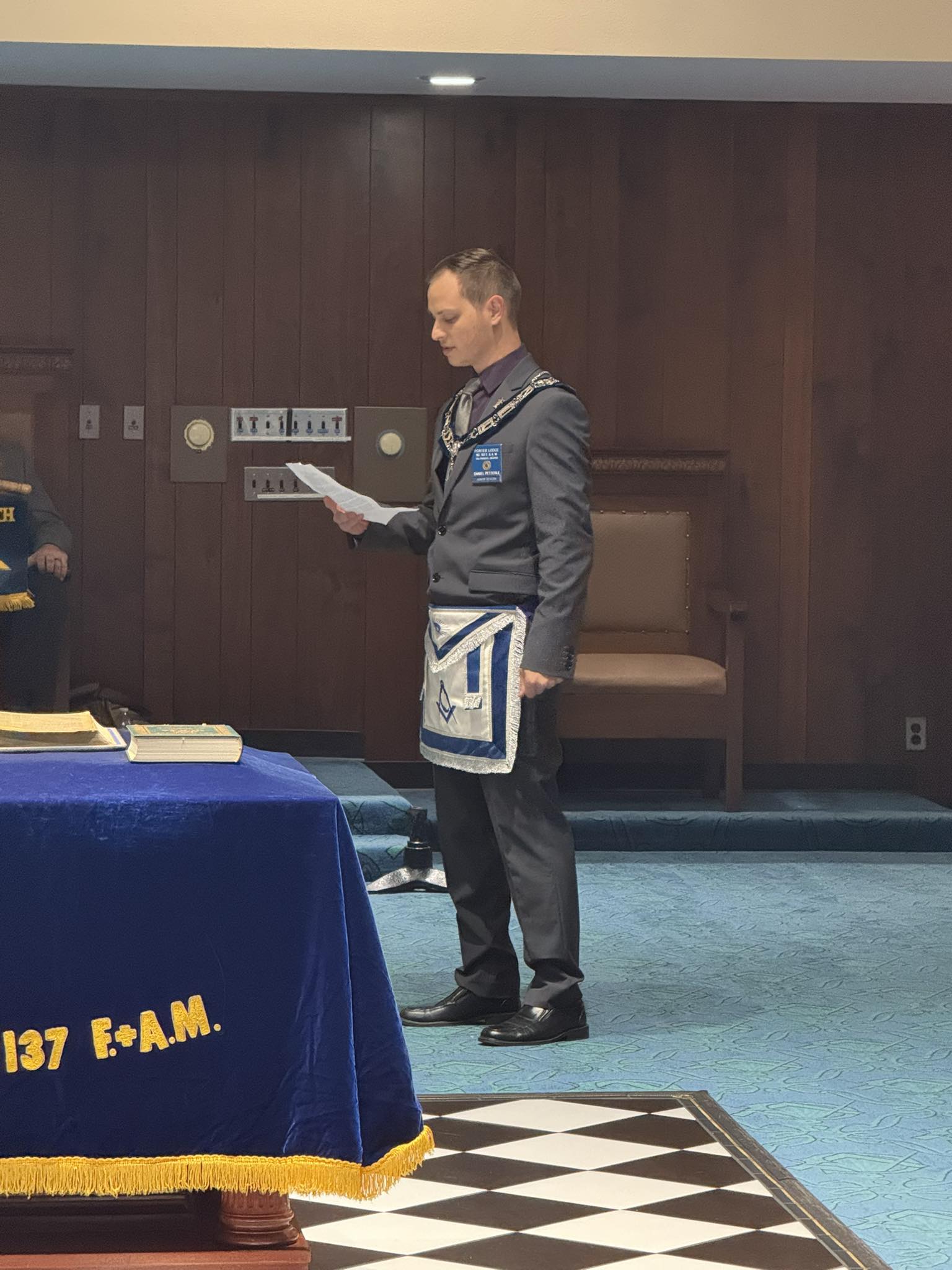
 Brethren, tonight I wish to speak with you about something simple yet profound: prayer. In Masonry we are builders, not merely of physical structures, but of inner temples composed of character, virtue, and service. Just as every operative builder requires plans and scaffolding, the speculative Mason needs guidance and support for his moral and spiritual construction. Prayer, in this sense, is the quiet architect of the soul. It frames our thoughts, humbles our hearts, and reminds us of the Great Architect of the Universe, under whose canopy we labor.
Although our Craft is not a religion, it rests firmly upon the belief in a Supreme Being. Because of that belief, prayer naturally finds its place in our ritual. Whenever we kneel at the altar or pause during our meetings, we recognize both our limitations as individuals and our unity as Brothers. Prayer in the lodge is not an imposition of doctrine but an invitation to harmony. Each Mason may silently shape the words to his own understanding while standing shoulder to shoulder with his Brethren.
This idea is ancient. It echoes through sacred scripture, which though revered differently by different faiths, offers timeless lessons for all. We see Solomon at the dedication of the Temple in Jerusalem, praying not for power or wealth but for wisdom and justice. We hear the Psalms with their cadence of gratitude and humility, their petitions for guidance, and their praise for virtue. The New Testament, too, speaks of prayer as a matter of sincerity and privacy, an inward conversation rather than a public performance. Such passages transcend creed or custom and stand as universal blueprints for the inner work every Mason must undertake.
Within our lodges, the Chaplain holds a special place in this process. He is not a gatekeeper to the Divine, but a guide, one who gives voice to our collective aspirations. When the Chaplain rises to pray at an opening, he invokes wisdom, harmony, and temperance. When he closes the lodge, he asks for safe travels, fraternal love, and perseverance in virtue. At dedications or memorials, he marks the transitions of life, providing words that honor the departed and re-center the living. His role reminds us that prayer is both communal and individual, his words form the framework, while our silent assent completes the circuit.
Yet prayer, in the Masonic sense, is not confined to lodge hours. It is meant to be a working tool, something to carry with you into daily life. Just as the square helps us shape our actions to virtue, prayer squares our inner motives with conscience. Just as the plumb keeps a structure upright, prayer keeps us upright in integrity. And just as the level reminds us of our equality, prayer reminds us of our shared dependence upon the Divine. In this way, prayer becomes a dynamic, daily act of reflection, humility, and inner alignment.
Now, allow me to expand this thought further. Prayer is not only an act of reverence, it is also an act of creation. Every word we speak, every thought we release, carries energy. Modern thinkers call this the law of attraction: the understanding that what we focus on, we draw toward us. Long before it had that name, wise men and prophets taught the same principle, that words have power. As the ancient proverb reminds us, ‘As a man thinketh in his heart, so is he.’ Those words, echoed through scripture and philosophy alike, remind us that thought precedes reality.
When we pray, we are doing more than speaking into the void; we are shaping the vibrations of our inner world and sending them outward, like ripples across still water.
In this light, prayer is a form of intention. When done with sincerity and alignment, it sets a pattern in motion. It is as if we send a message into the universe, a statement of faith, hope, and purpose, and in time, the universe reflects that vibration back to us. Masonry teaches us that thought precedes creation; that no edifice can rise until the plan has first been drawn. Likewise, prayer draws the plan. It outlines what we seek to build in our lives, peace, wisdom, health, compassion, and sets the tools of Providence in motion.
Think again of the compasses we open in our ritual. By opening them, we draw a sacred circle, a boundary between the profane and the purposeful. Prayer fills that circle with meaning and intention. Inside it, anger softens, perspective widens, and purpose strengthens. The noise of the outer world fades, and what remains is clarity. Through prayer, we bring order to the chaos of thought and harmony to the dissonance of emotion. The law of attraction, the principle of divine reciprocity, works quietly here: as we center our minds upon light, light returns to us. Brethren, as you progress through the degrees and through life, remember that prayer, whether spoken aloud or whispered in the heart, is the invisible cement binding your inner work. It lifts the mind from the material to the moral, from the transient to the timeless. It reminds us that creation begins in thought, that words are seeds, and that intention is the soil from which our future grows. Prayer is the quiet architect continually drawing and redrawing your inner blueprint, so your life may be built upon faith, fortified by hope, and ornamented with charity.
So tonight I charge you: see prayer not as a mere formality, but as a living force, an ongoing dialogue with the Great Architect of the Universe and with the universe itself. When you speak with gratitude, the world responds with abundance. When you ask for wisdom, opportunities for understanding will appear. When you pray for harmony, discord finds less ground to stand upon.
May your prayers, silent or spoken, be the scaffolding of your inner temple, the mortar binding your virtues, and the compass guiding your steps. In this way, the Mason’s path remains illuminated, and the lodge itself becomes not only a hall of fellowship but a sanctuary of the spirit, a place where intention, reflection, and brotherly love shape not only men, but the world they build together.
Dan Pettrele
Presented on 10/07/2025
