 I have been a freemason for 5 years now. Looking back over this journey on these years only taught me that this fraternity centers not on power, politics, or mystery—it is about people. Throughout my journey of these 5 years, I have been a part of a fraternity that, at its heart values, is about brotherhood, charity, integrity, and constant effort to become a better man through personal growth. The principles of Freemasonry are not just abstract concepts or ideas, but they are living values that guide and shape our actions and decisions. Inside the lodge, titles and social status are irrelevant and do not matter. A doctor, teacher, businessman, or laborer all meet on the same level, shoulder to shoulder, united by the shared commitment to becoming better men and united by that faith and purpose. Our aim is not to rule but to build that strong character, compassion, and understanding, both within ourselves and our communities.
On the other side of the world, the Middle East, a region I deeply respect and that holds some of the world’s richest spiritual traditions. Yet I see that Freemasonry is often pictured there in a very dark way. The image that is frequently portrayed is one of secrecy and suspicion. To many, the word “Freemason” has become shorthand for conspiracy and foreign control and carries negative connotations that bring about feelings of unease and mistrust. This misconception has been perpetuated for generations, and I feel compelled to share my personal experience, not to defend an institution, but to reveal the truth about a fraternity that has been misunderstood.
In many Middle Eastern countries, the mention of Freemasonry stirs up and causes controversy and suspicion.
Governments like Egypt, Saudi Arabia, and Iran have banned it outright, while others keep a cautious distance. The media and conspiracy-themed books have repeated the same accusations so many times that they have become ingrained in the public consciousness. Freemasons are often portrayed as political manipulators, tools of Western imperialism, or worse, agents of Zionism. Others accuse us of secretly worshiping something dark and denying God altogether.
It is not difficult to understand and see how and where these misconceptions came from. When European colonizers established lodges in cities like Istanbul, Beirut, and Cairo during the 19th century, they naturally attracted local elites and intellectuals. Over time, that image—European men meeting behind closed doors—became tangled with resentment toward colonial powers. Later, after World War II, political leaders like Nasser in Egypt and post-revolutionary Iran branded Freemasonry as a colonial relic or a Zionist plot, respectively. Even religious authorities issued decrees warning against it, and the rumors spread faster than the truth ever could.
To this day, I have met people who are genuinely afraid of Freemasons, believing that our rituals are satanic, that we seek to erase religion, or that we serve a global agenda to control the world. For them, the square and compass, symbols of morality and integrity, are seen as signs of something evil and sinister. I
can understand why they might hold these views and I cannot entirely blame them for that given the misinformation that has been perpetuated. However, the reality I know inside the lodge is very different.
Freemasonry is not about domination; it is about the focus on teaching discipline. It is not about secrecy; it is about symbolism. And it is not about rejecting God; it is about serving Him through good works and personal growth. To even join and become a Freemason, one must believe in a Supreme Being, which we refer to as the "Great Architect of the Universe” because our fraternity is open to men of all faiths. That is not negotiable. A Muslim, a Christian, and a Jew can all pray together, each in his own way, under the same roof, without conflict. An atheist, however, cannot be made a Mason, as the foundation of everything we do rests on faith in a divine Creator.
Our principles – Brotherly Love, Relief, and Truth – are not mere slogans; they are lived values to guide our actions. Brotherly Love means every person deserves dignity and kindness and treating others with respect and compassion, regardless of differences. Relief means charity, helping those in need, and supporting the sick, the poor, and the suffering. Truth means the pursuit of moral integrity, no matter how difficult or challenging it may be. All those mysterious "secrets" that outsiders often talk about are simply traditions – handshakes, words, and symbols that remind us to live with honesty, justice, and humility. They are not meant to hide evil; they are meant to preserve meaning, just like a family keeps certain customs private because they are sacred. We are not a secret society—we are a society with secrets.
What many people do not realize is that the values of Freemasonry and Islam are not in conflict; they often walk hand in hand. Both begin with a belief in one God, which Islam calls Tawhid and Masonry calls faith in the Great Architect. Both teach that charity is a duty, not an option. What Islam calls Zakat and Sadaqah, we call Relief – the moral obligation to give and to serve others. Both believe in the pursuit of knowledge as a sacred act. The Quran says, "Are those who know equal to those who do not know?” (Surah Az-Zumar / Chapter 39, verse 9) and Masonry echoes this idea through its call to seek Light – knowledge, wisdom, and understanding.
Even our initiations, often misunderstood, resemble the journey of spiritual brotherhood found in Sufi traditions. Each degree is a symbolic step inward, a lesson in humility, service, and reflection. A sincere Muslim can be a sincere Mason, just as a Christian or Jew can, because nothing in Masonry replaces or contradicts his faith. In fact, for many, it strengthens it. The obligations we take never ask a man to put the fraternity duties above his God, his family, or his country. They simply call him to live by higher moral standards in all three.
If our values are so aligned, why does the hostility endure? The answer lies in history and fear. The scars of colonialism still run deep, and Masonry's European roots made it an easy target. Add in political agendas, clerical warnings, and the global obsession with conspiracy, and you get a myth too dramatic to die. Modern media platforms have not helped, as online videos and sensational "exposés" recycle the same baseless claims, tying every world event to Masonic influence. It is easier for people to believe in a hidden villain than to accept the messy, ordinary truth – that Freemasonry is simply a voluntary fellowship of men trying to do good.
And to be fair, we Masons have not always done a great job explaining ourselves. Our quiet and peaceful nature, our refusal to shout back at lies, has sometimes allowed fear to fill the silence. But silence can also be interpreted as guilt. That is why conversations like this matter. I do not expect the walls of suspicion to fall overnight. Centuries of misunderstanding cannot be undone with a single essay. However, I do believe in dialogue – real, respectful dialogue. I believe a Muslim cleric and a Mason can find common ground and sit at the same table and realize they both serve the same divine cause: to uplift humanity, to practice compassion, and to live in truth.
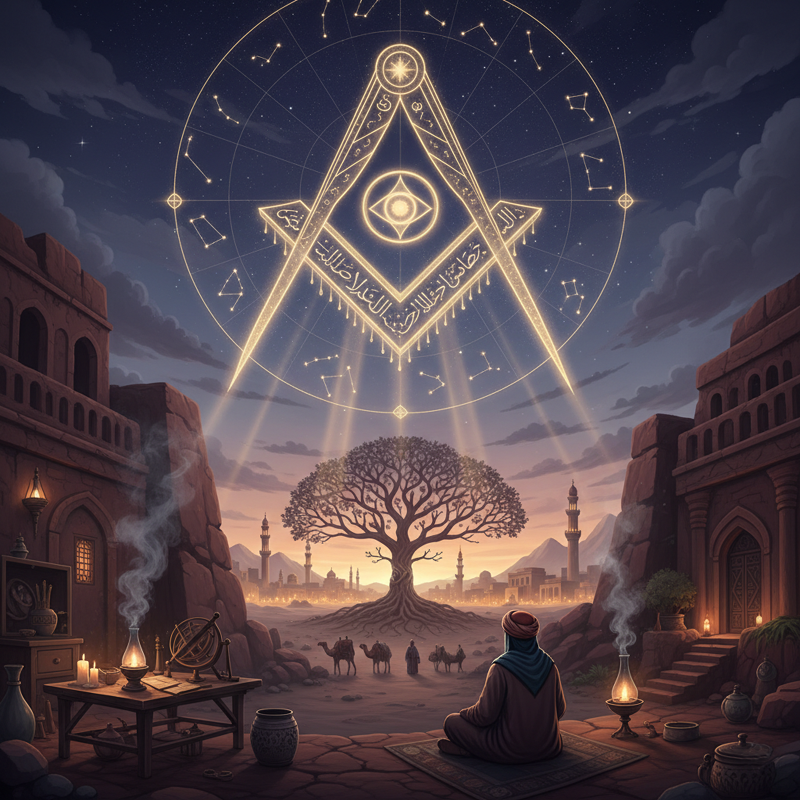
The Freemasonry I know is not about secret power; it is about uniting members through shared objectives and purpose instead of using secret control methods. It is not about the West or the East; it is about what is right and morally correct. I have seen brothers of every color and creed work side by side to feed the hungry, rebuild after disasters, and comfort the lonely. That is not the work of a cabal; it is the work of men who care. If there is a light I hope to leave shining through these words, it is this: the square and compass do not oppose the crescent. They reflect it. Both point toward the same heaven, the same truth, and the same call to goodness. The only real enemy between us is ignorance – and that is a wall both faith and fraternity can tear down, brick by brick.
In the end, the responsibility lies with Freemasons to reveal, be more open, and transparent about our values, practices, and core beliefs. We must engage in respectful dialogue and communication with those who may have misconceptions and incorrect beliefs about our fraternity. By doing so, we can work towards a greater understanding and mutual respect. The upcoming journey will be difficult and not easy, but it is a necessary step towards building bridges of understanding between different cultures and faiths. As Freemasons, we are committed to the pursuit of knowledge, wisdom, and understanding. We recognize that our fraternity is not a substitute for faith, but rather a complement to it. By working together, we can create a brighter future, one that is built on the principles of brotherly love, relief, and truth.
Brother Ahmed Al-Mohammed Saleh SD, 32° Scottish Rite
