Every Masonic Lodge brings together all kinds of men. Some are confident speakers, comfortable in conversation and naturally able to read the room around them. Others are more quiet, more reserved, or simply different in how they interact with people. Being in the Lodge room doesn’t change these characteristics, and at times it may even highlight that we are all rough ashlars in different stages of being shaped.
Masonry claims to take good men and makes them better, but that doesn’t happen just by going through the Degrees or studying the ritual. Yes, the rituals are powerful, touching the heart and souls of those who experience them, But the claim of making good men better becomes actualized when the Lodge is closed. When we are just men talking to men.
From time to time a lodge encounters a brother who struggles socially. His intentions may be sincere, yet his words miss their mark. What he believes to be helpful advice may sound, to others, like criticism or superiority. Often such a brother speaks plainly without realizing how his words may be interpreted. Over time, this lack of awareness creates discomfort, conversations become tense, and some Brethren begin to avoid the Brother. He may be quietly mocked, as Brothers speak about him behind his back. Eventually this Brother might find himself isolated within the very fraternity that promised him Brotherhood and fellowship.
These situations tend to reveal what a Lodge and their Brethren are really composed of. It is easy to embrace Brotherhood when it is convenient. It is easy to practice kindness toward those who are socially polished, agreeable, and like-minded. But the true test of Brotherhood occurs when we encounter a man who challenges our patience, who communicates differently, or who simply does not fit the rhythm of the Lodge.
There are times when many choose distance, justifying their avoidance by saying the Brother is difficult. Others may laugh quietly among themselves. They speak about him when they should be speaking to him. Yet such reactions stand in quiet contradiction to the principles that every Mason promises to uphold. Our obligations speak clearly of Brotherly love, Relief, and Truth. These are not abstract ideals meant only for ritual language but rather these are the standards meant to guide our conduct toward one another.
But every now and then, a brother chooses a different path.
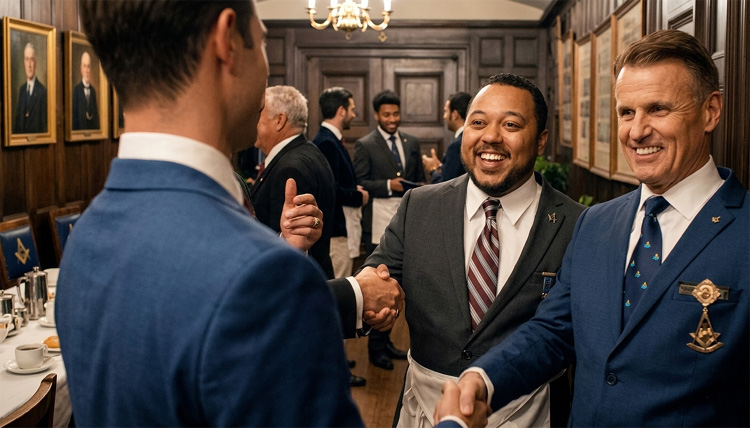
Recently, I observed a Brother address this matter in accordance with Masonic principles. He did so quietly and without seeking recognition. Instead of withdrawing, he stepped forward. Instead of joining criticism, he showed patience. Instead of allowing misunderstandings to deepen, he offered gentle counsel and guidance.
He simply treated the Brother with dignity. He spoke to him rather than about him. When guidance was needed, he offered it kindly. When conversation became difficult, he responded with patience versus irritation. He did not excuse poor communication, but neither did he allow a brother to become isolated. In doing so, he demonstrated something that cannot be learned from memory work alone. He showed what it truly means to live the principles of Masonry outside the ritual or lodge room.
Watching how our Brother treated a fellow Brother had a profound effect on me. It reminded me of that solemn moment, surrounded by Brethren and illuminated by the Great Lights of Masonry, when we freely and voluntarily take upon ourselves those sacred obligations. In those moments we pledge ourselves to the principles of Brotherly Love, Relief, and Truth. We promise to regard every Mason as a Brother and commit ourselves to act with kindness, charity, and patience toward those who share that sacred bond.
It is easy to speak about Brotherly Love. It is easy to repeat the beautiful lessons contained within our ritual. Masonry is not proven by how well we recite its teachings rather it is proven by how we can faithfully apply these teachings when dealing with one another.
That is exactly what this brother has done.
He remembered that every Mason came to the altar seeking light. He remembered that each man in the Lodge took the same obligations and was welcomed into the same circle of Brotherhood. He remembered that the principles of Masonry are not meant to be applied selectively, but universally.
In a quiet and unassuming way, he embodied the teachings that many of us recite but failed to apply.
His example reminded me that a Lodge that truly practices Brotherly Love becomes a place where men are not merely tolerated but supported. It becomes a place where growth is encouraged, and where differences in personality are met with patience.
More importantly, it reminded me that many men hold the title of “Mason,” but the true Mason is recognized by his actions, and personal growth versus the apron he wears or the titles he gained. By choosing friendship over avoidance, guidance over criticism, and kindness over judgment, this brother demonstrated the very heart of the Craft. This Brother reminded me that our obligations are the standard by which we all should strive to measure our lives.
Robert Easton, PM



