The new year is around the corner, and with that comes renewal. Renewal of things both old and maybe not so old. Another beginning. As humans, we see the world and time in an odd way; we see things linearly. That is, we need a beginning, a middle, and an end. From death springs new life. Life is, after all, an amazing cycle. In Masonic philosophy, this cycle mirrors the doctrine of regeneration or “eternal becoming,” where the soul undergoes perpetual renewal through trials, self-conquest, and initiation—transforming the profane into the spiritual, much like the serpent shedding its skin or the sun’s daily rebirth symbolized by Harpocrates.
Although you may think at this point in this piece I am going to tell you to renew your Masonic something rather for the new year, rest easy. I’m not going to do that. But I will regale you with the tale of Harpocrates, or as he may have been known to ancient Egyptians, Har-Pi-Krati. He was a god-like child figure, often depicted in the nude and sitting on a lotus flower. He is considered in the Egyptian culture as most likely representing a renewal and new year because of a yearly consecration of peach blossoms, which were given to his busts and carvings. Also, because he was the representation of Horus as a god-child, Horus represented the newborn sun at each new dawn. The lotus flower upon which Harpocrates sits symbolizes spiritual rebirth and elevation, emerging from primordial waters to represent the soul’s ascent from material darkness to enlightenment — a motif echoed in Masonic teachings on purification and light. Philosophically, Freemasonry teaches that true renewal comes via the unity of God and soul immortality, with Harpocrates embodying the aspirant’s journey from ignorance to wisdom, guarded by silence until inner light dawns.
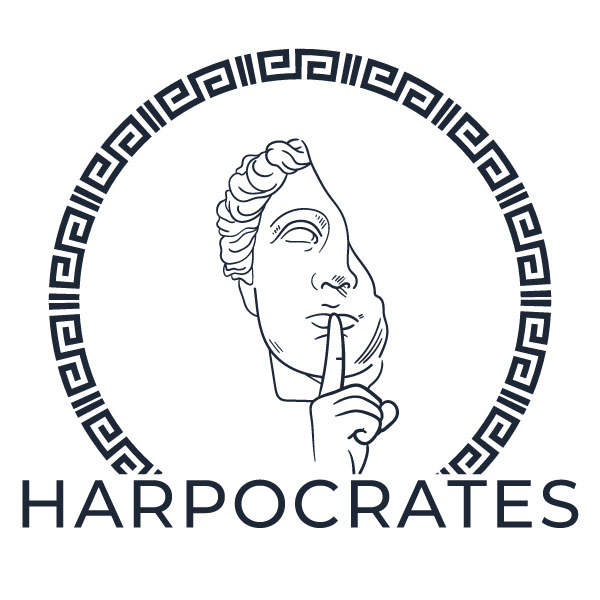 Masonically, there is a cooler connection, which is that of secrecy. Typically, in his depictions, Harpocrates was shown with his finger to his lips, as if telling us to keep a secret. This gesture, originally a hieroglyphic sign for “child” in Egyptian iconography, was misinterpreted by Greeks and Romans as a sign of silence, and it evolved into a core Masonic emblem of discretion and the obligation to guard esoteric knowledge. In Freemasonry, Harpocrates appears on jewels like the Stewards’ jewel, often with a cornucopia (horn of plenty) and the motto “Audi, Vide, Tace” (“Hear, See, Be Silent”), reminding Brethren of their vows during initiation rites where silence is a primary virtue for the Entered Apprentice. Some lodges even incorporate Harpocrates into their names or rituals, linking him to the Hiram Abiff legend as a “Widow’s Son” figure akin to Horus, son of Isis and Osiris, symbolizing resurrection and the restoration of lost wisdom—philosophically underscoring Freemasonry’s core tenets of moral rebirth and the eternal quest for divine truth.
So, when the Romans conquered Egypt and adopted this god, they gave him the name we have today, Harpocrates or Heru-pa-khered, which meant Horus the Child. At some point, they lose the idea of renewal and focus on the outward appearance, and subsequently associate him with representing secrecy, something all Freemasons value. So, remember to keep the secrets, Brothers! For the Lyceum, reflect on how Harpocrates bridges renewal and silence: just as the newborn sun renews daily, the Mason renews his commitment to sacred silence, protecting the “ineffable” truths until worthy light reveals them—echoing the speculative philosophy that initiation fosters an “internal process” of self-perfection, where silence suffered in apprenticeship births profound understanding.
by RWB:. Robert H. Johnson, FILOR
(Published in The January edition of Lyceum, a publication of the Committee on Masonic education of the Grand Lodge of Illinois)



