In the Mystery traditions of the world, vesture is never a decoration; it is an investiture. The apron, the girdle, and the sash are not merely worn, they are conferred; and what is conferred is a visible covenant, a public sign that the inward man has accepted discipline, purification, and service. The ancient Schools understood what the modern world forgets, that the soul is trained not only by doctrines heard, but by symbols carried upon the body; for the body is the outer temple, and every sacred garment is a reminder at the threshold of action.
The apron stands first among these emblems, because it speaks the first moral necessity of initiation, namely purity united to labor. In the old sanctuaries the neophyte did not approach light as a spectator, but as a workman; he was not admitted to admire Wisdom as a picture, but to serve it as a craft. Thus the apron becomes the quiet proclamation that enlightenment is inseparable from upright conduct, and that holiness is proved in the workshop of life. More than one initiatic lineage declares the essential signification of the apron to be purity; it is whiteness set before the eyes of the candidate, that he may remember, amid the stains of the world, the cleanliness of intention demanded by the altar.
This same doctrine appears with solemn clarity in the priestly vestures of the ancient Hebrew economy, where the linen apron or girdle, worn “for glory and for beauty,” is treated as a mark of consecration; it binds the officiant to a standard of holiness, as though to say, “The hands that serve must be clean, and the life behind the hands must be cleaner still.” The garment becomes a moral tether; it does not confer virtue by magic, but it summons virtue by memory. It is a continual admonition, gentle yet inexorable.
The girdle, often paired with the apron, and in some rites preceding it, expresses another necessity: restraint, gathered power, and readiness. To be “girt” is to have wandering energies bound to purpose; it is the emblem of a man collected within himself, able to stand, travel, and endure. In the Mithraic initiations, the candidate is invested successively, receiving a girdle before the final reception of the white apron; the sequence is instructive, for the powers must be disciplined before they can be made pure, and the will must be gathered before the life can be made luminous. The girdle teaches self-government; it is the silent maxim, “Rule thyself, lest the world rule thee.”
The sash, especially in its diagonal form, adds yet another layer of meaning: transmission and obligation in motion. The ancient Indian sacred sash, the zennaar, is described as a cord of nine threads, knotted, worn from the left shoulder to the right hip; and it has been compared, in direction and symbolic intent, with the initiatic scarf of later fraternities, likewise worn from left to right. The diagonal line across the body is itself a hieroglyph. It crosses heart and hand, intention and deed; it suggests that sacred knowledge is not a jewel to be hoarded in the mind, but a current to be conducted into the world. It is the sign of a charge carried, a duty that accompanies the initiate wherever he walks.
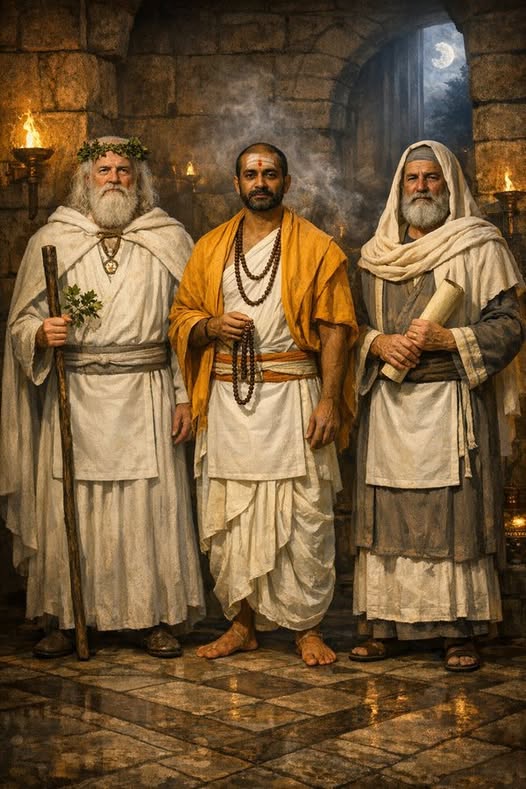
When one surveys the breadth of tradition, one discovers a remarkable constancy beneath local variations. Among the Essenes, the novice receives a white robe, again proclaiming separation from the common life and the ethical demand of purification. In Scandinavia, the emblem is translated into a white shield, yet it is presented with instruction “not very dissimilar” to that connected with the apron; the outer form changes with the genius of the people, but the inner intention remains. The Mysteries are not uniform in costume, yet they are one in principle: a visible pledge of inward cleansing, disciplined power, and vowed service.
In Freemasonry, this ancient language of vesture is preserved with a peculiar tenderness. The apron is called the badge of the Mason, and it is given early, as if the Order would say, “Before you dispute about mysteries, be pure; before you aspire to honors, labor.” In the documentary memory of the Craft, we can trace the transition from the more massive and plainly practical badges of earlier times to later forms edged, lined, or distinguished by color; and yet the moral heart remains unaltered: the emblem is still a reminder that the dignity of the initiate is measured by his rectitude, not by his ornament.
There is, moreover, a deeper secret hinted by certain interpreters: that the apron is not only a garment, but a diagram, a silent lesson in proportion, squareness, and the reconciliation of opposites. One writer reads the apron as a kind of geometrical meditation, tied to the square and the “squared circle,” implying that initiation seeks to harmonize what seems irreconcilable, to bring the circle of heaven into the square of earth, and to make a moral architecture of the life. Whether one accepts this as history or as contemplative allegory, it reveals the initiatic method: the simplest thing, faithfully regarded, becomes a door into philosophy.
Thus the apron teaches purity in labor; the girdle teaches restraint and readiness; the sash teaches obligation and transmission. All three declare, in their several accents, that initiation is not a costume drama, but a consecration; not an escape from the world, but a better manner of walking within it. The Mysteries clothe the candidate so that he may remember, at the point of choice, what he has vowed at the point of light. And if the world asks why these humble textiles endure, the answer is plain: because the soul is educated by symbols that can be carried, and the truest knowledge is that which follows a man into the deeds of his day.
Universal Co-Masonry's Post on Facebook



