Freemasonry has long encouraged the study of the Liberal Arts and Sciences. This is not offered as a casual suggestion, nor as an academic formality. It is a directive with purpose. We are meant to study, not simply to know more, but to understand more. The world around us is not a backdrop. It is a text, and we are expected to read it.
At first, this instruction can seem modest. We are told that the Liberal Arts polish and adorn the mind, and that Geometry is the foundation of our art. Many hear this and think of school lessons, formulas, and diagrams long forgotten. It is easy to assume that the point is education in the ordinary sense. It is not.
The study of the sciences, and Geometry in particular, trains us to recognize order. It teaches us that beneath what appears to be complexity lies structure, and beneath structure lies consistency. It gives us a way to look at the world that goes beyond surface impressions.
Once you begin to see this way, the world changes. Consider the motion of the heavens.
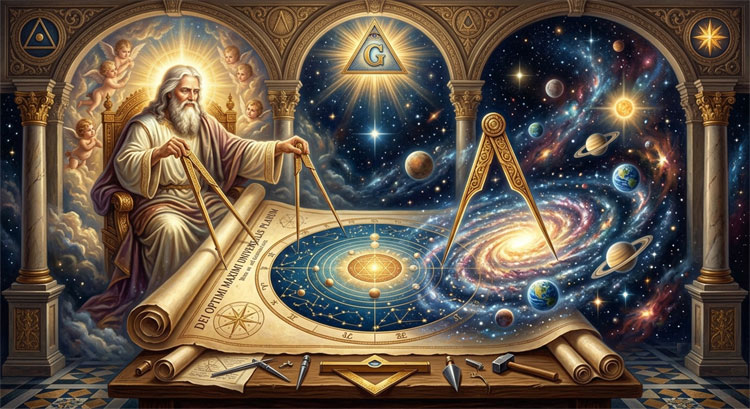
The planets do not wander aimlessly through the sky. Their paths are exact. Their movements can be calculated with astonishing precision. Eclipses occur at predicted times. Seasons arrive in their proper order. The same patterns repeat, not approximately, but reliably.
Closer to home, the same principle holds. The tides rise and fall according to measurable forces. Light behaves in predictable ways. Matter organizes itself into stable forms. Even the smallest particles follow rules that can be studied, described, and anticipated. This is not chaos. It is order of the highest kind.
The study of science reveals these patterns. Geometry gives us the language to describe them. Together, they allow us to see that the universe operates according to unfailing laws. We rely on them every day. We build structures that stand because we trust these laws. We navigate the world because we trust these laws. We make predictions because we trust these laws. But trust invites a question. In whom do we trust?
Freemasonry does not approach this question timidly. It does not suggest that the order we observe is accidental, nor does it treat it as a mystery beyond consideration. Instead, it invites us to reason from what we see.
Imagine yourself alone in a vast desert. There is no sign of life. No footprints. No roads. No evidence that anyone has ever passed that way. As you walk, you come upon a pocket watch lying in the sand. It is intact. It is running. The time it displays matches the clock on your cell phone.
You would not hesitate for a moment in your conclusion. The watch did not assemble itself. It did not wind itself. It did not arrive there by chance. Its very existence, and its continued operation, are proof that it was made, and that it was handled by an intelligent being. The watch is not merely a suggestion of a maker, It is proof of one.
The universe presents us with something far greater than a watch. We do not observe a single mechanism, but an entire system of interdependent processes, each operating with precision. The more closely we examine it, the more intricate it becomes. From the movement of galaxies to the behavior of the smallest particles, everything follows laws that are consistent and intelligible.
This is not a loose arrangement. It is a coherent system. When we discover order, we are not discovering randomness that happens to repeat. We are discovering structure that has been laid out in advance. The laws of physics are not suggestions. They are constraints that govern everything that exists.
This is where the lessons of the Liberal Arts and Sciences become clear. The order we observe is not merely evidence of a system. It is the signature of its author. The pocket watch in the desert tells us that someone was there. The order of the universe tells us that Someone is here. Not in a distant or abstract way, but in the very structure of reality itself.
Every predictable orbit, every consistent law, every measurable relationship is a mark left behind by the intelligence that designed it. It is, quite literally, the Creator’s thumbprint on the plans.
We often think of proof as something confined to mathematics or experiment. Something that can be written down and verified step by step. But there is another kind of proof, one that arises from recognition. When the human mind encounters order of a certain kind, it cannot help but infer intention. We recognize design because we are capable of it ourselves. We know what it means to plan, to measure, to construct. When we see those same qualities on a scale far beyond our own, the conclusion follows naturally.
Freemasonry begins with the assumption of a Great Architect of the Universe. The study of the Liberal Arts and Sciences does not replace that assumption. It confirms it, reinforces it, and gives it depth. Astronomy shows us the scale of the design. Physics reveals the rules that govern it. Geometry provides the framework through which it can be understood.
Each discipline adds clarity, not by changing the conclusion, but by making it unavoidable.
At the same time, this study teaches humility. We are not the authors of these plans. We are the observers of them. Our understanding is partial, our tools are limited, and our perspective is narrow. Yet even within those limits, we can see enough to recognize that the universe is not self-creating. It bears the marks of intention.
Freemasonry does not ask us to solve the universe. It asks us to study it. To observe carefully, to think honestly, and to draw conclusions that are consistent with what we see. The more we do this, the more difficult it becomes to dismiss the order around us as accidental. The patterns are too consistent. The structure is too precise. The system is too complete. The thumbprints are everywhere.
The study of the Liberal Arts and Sciences is therefore not an academic exercise. It is a method of learning to recognize the work of the Great Architect. Every law we discover, every pattern we understand, every measurement we confirm brings us one step closer to appreciating His designs. We may never meet the Architect. That is not required. It is enough to see His work, and to recognize His mark upon it.
by RWB Chad M. Lacek, 33˚
This article was originally published in the Lyceum (The Official Monthly Masonic Education Publication from the Grand Lodge of Illinois), April 2026



