Freemasonry, like many long-standing fraternal organizations, occasionally faces a quiet challenge that is often more felt than spoken about: members drifting away after a period of initial enthusiasm. This is not usually the result of a single cause or dramatic turning point, but rather a gradual fading of connection, purpose, or engagement. Understanding why this happens requires looking at the human side of membership as much as the structural or organizational side, because disengagement is rarely sudden; it is usually the outcome of accumulated small gaps between expectation and experience.
When a new member first joins Freemasonry, there is often a strong sense of curiosity and inspiration. The ceremonies feel meaningful, the symbolism appears rich with depth, and the sense of belonging to something historic and larger than oneself can be powerful. In these early stages, enthusiasm tends to be high, supported by the novelty of initiation and progression through the degrees. However, once that initial movement slows and the member enters the regular rhythm of lodge life, a shift often occurs. Meetings can become predictable, administrative tasks can dominate the evening, and ritual, when repeated without deeper reflection or explanation, may begin to feel procedural rather than transformative. Without a clear continuation of personal growth or new challenges, that early momentum can gradually weaken.
A significant contributing factor is the quality of personal connection within the lodge. Freemasonry is fundamentally built on the ideal of brotherhood, yet meaningful relationships do not automatically develop simply through shared membership. It is possible for a member to attend regularly and still feel socially on the periphery. When someone does not feel personally known, remembered in absence, or naturally included in conversation, attendance can slowly feel less essential. Over time, the absence of strong interpersonal bonds can make disengagement feel easier than continued participation, even when no active dissatisfaction exists.
Life circumstances also play a powerful role in shaping engagement. As work responsibilities increase, families grow, financial pressures shift, or health changes arise, time becomes a limited resource. Freemasonry, like any voluntary commitment, competes with these realities. If the lodge experience does not adapt to fluctuating availability or offer a sense of continuity during periods of absence, members may drift away not out of rejection, but out of practicality, sometimes without intending it to be permanent.
Another important element is the question of perceived purpose and relevance. Many members, after initial participation, begin to ask—sometimes quietly—what they are truly gaining or contributing. If lodge life becomes overly focused on procedural matters without a strong emphasis on learning, service, or meaningful engagement, motivation can diminish. People are naturally drawn to experiences that feel significant, and when that sense of significance is not reinforced, interest tends to fade.
This is often intensified when ritual is experienced without sufficient context. Ceremonies that are performed correctly but not explored deeply can lose their impact over time. Without explanation, reflection, or discussion, symbolism may remain at the surface level, and what was once felt as profound can gradually become familiar repetition. When intellectual and emotional understanding does not evolve alongside participation, connection to the experience weakens.
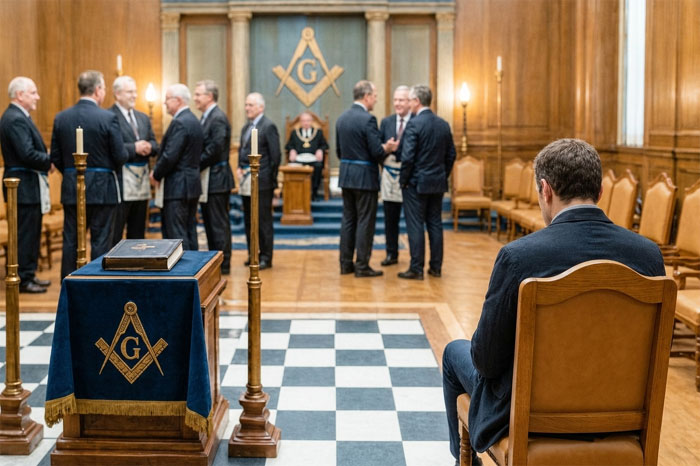
Communication gaps also quietly contribute to disengagement. When members do not feel consistently informed or included in the ongoing life of the lodge, they can begin to feel disconnected from its direction and community. In any organization, silence is often interpreted as distance, even when no exclusion is intended.
A further structural challenge lies in what many describe as a “revolving door” effect, where members join with enthusiasm but leave within a few years. This is often linked to an expectation gap between perception and reality. Public imagination sometimes frames Freemasonry as something mysterious and transformative, while the lived experience is closer to a volunteer-based fraternity that requires patience, service, and steady commitment. When expectations are not aligned with reality, early enthusiasm can erode.
This is sometimes compounded by overly administrative lodge meetings, where significant time is spent on routine business. For a newer member seeking learning, inspiration, or philosophical engagement, evenings dominated by procedural matters can feel underwhelming. At the same time, mentorship is often strongest during early degrees but weakens after advancement, leaving newer Master Masons without consistent guidance or integration. If the social structure of the lodge is also divided into established groups, newer members may struggle to find their place within it.
Addressing these challenges requires attention not to a single fix but to the overall culture of the lodge experience. Stronger personal relationships are essential, because when members feel genuinely connected, attendance becomes meaningful rather than obligatory. Mentorship should extend beyond ritual instruction into ongoing inclusion, ensuring that newer members are not only taught but also integrated into the social fabric of the lodge. Equally important is the need to balance administrative necessity with intellectual and philosophical substance, so that meetings provide not just structure but value and reflection.
Social cohesion also plays a central role in retention. Shared meals, informal gatherings, and non-ritual activities help transform the lodge from a formal obligation into a living community. When members connect as people rather than only as officers or participants in ritual, bonds strengthen naturally. In addition, proactive communication and simple personal outreach when someone is absent for a period can make a significant difference. Often, a brief and sincere check-in is enough to remind a member that they are missed and still valued.
Flexibility is equally important. Members move through different phases of life, and lodges that acknowledge this without judgment tend to retain connection even during periods of reduced attendance. A sense that one can step back temporarily without losing belonging often increases the likelihood of long-term return.
Ultimately, members do not usually drift away because of a single disappointment. More often, disengagement emerges when connection to people, purpose, and personal growth slowly weakens over time. When Freemasonry is experienced only as tradition, obligation, or routine, it risks becoming static. But when it is lived as a space for learning, friendship, and meaningful participation, it remains relevant across changing seasons of life. A lodge is not simply an organization or a building; it is a circle of men, and when that circle remains open, supportive, and engaging, members do not merely attend—they belong.
***Be kind, be curious, and always remember that a single act of kindness can make all the difference.
WB Lucas Pacukovski, PM, 33°



